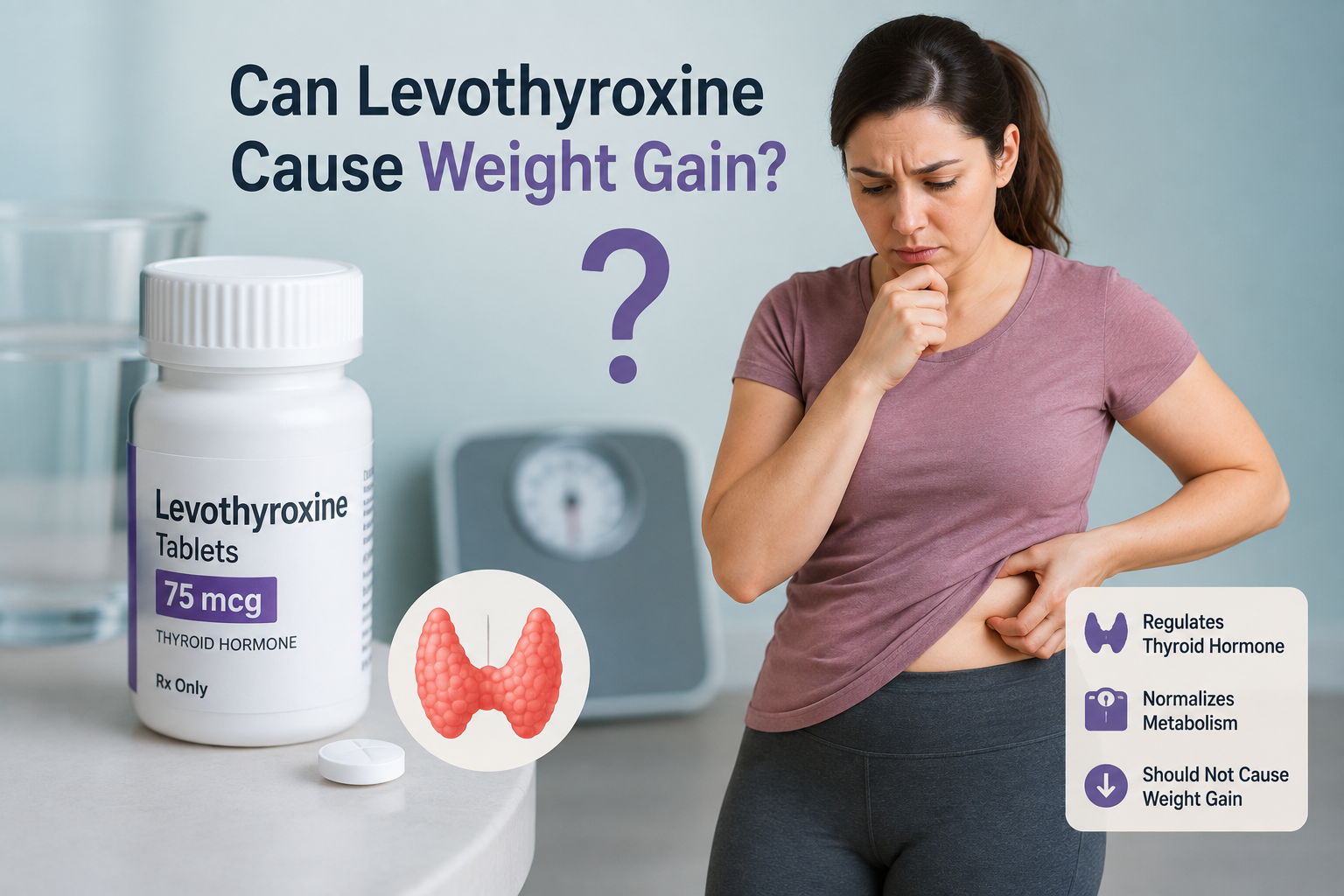
If you are wondering can levothyroxine cause weight gain, the medication itself usually works in the opposite direction by correcting the low-thyroid state that can contribute to weight gain. If weight keeps rising after treatment starts, the next step is to investigate dose, absorption, timing, and other possible causes.
Levothyroxine is prescribed to replace thyroid hormone when the body is not making enough of it. Because untreated hypothyroidism can slow metabolism, increase fluid retention, and contribute to modest weight gain, many people expect the scale to move down once treatment begins.
Sometimes it does. Sometimes weight barely changes. And sometimes the scale goes up even after levothyroxine is started.
That does not automatically mean levothyroxine is causing fat gain. In many cases, persistent or new weight gain points to undertreated hypothyroidism, inconsistent absorption of the medicine, a change in dose needs, fluid retention, or a completely separate issue such as another medication, sleep loss, menopause, reduced activity, or a metabolic condition.
The American Thyroid Association notes that hypothyroidism-related weight gain is usually modest and often includes retained salt and water rather than only body fat. It also recommends repeat TSH testing after dose changes and a review when body weight changes substantially.
| KEY TAKEAWAYS
· Levothyroxine is not generally considered a weight-gain drug. It replaces thyroid hormone that the body is missing. · Weight gain after starting treatment can happen if the dose is too low, doses are missed, absorption is reduced, or thyroid needs have changed. · Calcium, iron, some foods, certain stomach medicines, and inconsistent timing can reduce levothyroxine absorption. · A normal TSH makes uncontrolled hypothyroidism a less likely explanation for ongoing weight gain. · Do not increase levothyroxine on your own to lose weight. Excess thyroid hormone can cause heart rhythm problems, bone loss, and other serious effects. · Rapid weight gain with swelling, shortness of breath, chest symptoms, or severe weakness needs prompt medical evaluation. |
Checkpoint 1: Is Your TSH Actually in the Target Range?
If the scale is rising, the first question is not whether levothyroxine is ‘fattening.’ It is whether the dose is restoring thyroid hormone levels adequately.
TSH is the main blood test used to monitor most adults taking levothyroxine for primary hypothyroidism. When thyroid hormone levels are too low, TSH usually rises because the pituitary gland is signaling for more thyroid hormone.
A persistently high TSH can mean the dose is too low, medication is not being absorbed consistently, doses are being missed, or the body now needs a different amount.
The American Thyroid Association advises checking TSH roughly 6 to 10 weeks after a levothyroxine dose change because the hormone and pituitary response need time to reach a new steady state. Once the dose is stable, testing is commonly spaced farther apart.
If your TSH is still above the treatment target and you also have fatigue, constipation, cold intolerance, dry skin, or swelling, ongoing hypothyroidism is a more plausible explanation for weight gain than a direct effect of levothyroxine.
Checkpoint 2: Did the Weight Gain Start Before the Medicine Had Time to Work?
Levothyroxine does not correct hypothyroidism overnight. Symptoms can improve gradually, and blood tests are not usually rechecked immediately after treatment begins.
Someone who starts treatment while already gaining weight may continue to see the scale rise for a period before thyroid levels normalize. The timing can make it look as though the medication caused the gain when the underlying disease was still active.
Another source of confusion is expectation. Treating hypothyroidism does not guarantee dramatic weight loss. The American Thyroid Association explains that only part of hypothyroidism-related weight is usually attributable to the thyroid itself, and much of that may be salt and water.
Once thyroid levels normalize, future weight gain and loss are generally influenced by the same broad factors that affect people without hypothyroidism.
Checkpoint 3: Is Levothyroxine Being Absorbed Consistently?
A prescription can be correct on paper and still behave like an inadequate dose if absorption is inconsistent.
Current MedlinePlus levothyroxine guidance recommends taking levothyroxine on an empty stomach, usually 30 minutes to 1 hour before breakfast, unless a clinician has given a different plan. Consistency is critical.
Common absorption problems include:
- Taking levothyroxine with breakfast on some days and fasting on others.
- Taking calcium or iron supplements too close to the thyroid pill.
- Using certain antacids, bile-acid binders, or other medicines that interfere with absorption.
- Drinking coffee very soon after the dose.
- Large changes in soy or high-fiber intake.
- Gastrointestinal conditions that interfere with absorption.
- Missing doses and trying to compensate inconsistently.
Calcium and iron are among the most common issues. They can bind levothyroxine in the digestive tract and reduce how much reaches the bloodstream. Many clinicians recommend separating these supplements from levothyroxine by several hours.
In March 2026, the American Thyroid Association summarized newer research on taking levothyroxine with breakfast in selected patients. The practical message was not that timing no longer matters. It was that some patients may be able to use an alternative schedule if the dose and TSH are monitored appropriately. Changing your routine without follow-up testing can still destabilize control.
Checkpoint 4: Has Your Dose Requirement Changed?
Levothyroxine dosing is not always permanent at one exact microgram amount.
Dose needs can change after significant weight gain or loss, pregnancy, menopause-related hormone therapy, starting or stopping estrogen, changing brands or formulations, beginning medicines that alter absorption, or developing gastrointestinal disease.
The American Thyroid Association specifically advises contacting a clinician after a substantial weight change because dose requirements may shift.
Pregnancy deserves special attention. Thyroid hormone requirements often increase early in pregnancy, so someone who was well controlled before pregnancy can become undertreated if the dose is not adjusted promptly.
A change from one levothyroxine manufacturer or formulation to another can also justify repeat TSH testing in some patients, especially when symptoms change.
Checkpoint 5: Is the Thyroid Actually the Cause?
This is the checkpoint that prevents endless dose escalation.
If TSH is in the treatment target, the medicine is being taken consistently, and symptoms of hypothyroidism have improved, persistent weight gain may not be thyroid-driven.
Other possibilities include:
- Reduced physical activity after injury, illness, or a lifestyle change.
- Sleep deprivation or untreated sleep apnea.
- Menopause or perimenopause.
- Polycystic ovary syndrome.
- Depression, chronic stress, or changes in appetite.
- Medicines such as corticosteroids, some antidepressants, antipsychotics, certain diabetes medicines, and some blood pressure drugs.
- Fluid retention related to heart, kidney, or liver disease.
- Changes in alcohol intake, portion size, or highly processed foods.
This is why the scale alone is not a reliable way to decide whether a levothyroxine dose is correct. Thyroid blood tests, symptoms, medication timing, and the broader medical picture need to be considered together.
A Quick Decision Tree for Weight Gain on Levothyroxine
| What You See | What It May Mean | Next Step |
| TSH is high | Undertreatment, missed doses, absorption problem, or changed dose need | Review dose and how the medicine is taken |
| TSH is normal, symptoms improved | Thyroid is less likely to be the main cause | Look for non-thyroid causes of weight gain |
| TSH is low | Possible over-replacement | Do not take extra hormone; clinician may need to lower dose |
| Weight gain is rapid with swelling | Possible fluid retention or another medical problem | Seek prompt medical evaluation |
| Pregnant or newly pregnant | Dose needs may rise quickly | Contact thyroid or obstetric clinician promptly |
Can Levothyroxine Itself Cause Weight Gain as a Side Effect?
Drug information sources may list both weight gain and weight loss among reported effects. That does not mean levothyroxine commonly causes fat gain through a direct drug mechanism.
The more clinically useful interpretation is that weight can change while thyroid levels are being corrected, while the dose is being adjusted, or because the underlying hypothyroidism is not yet controlled.
If someone gains weight after starting levothyroxine, the right response is not to assume the drug must be stopped. Levothyroxine is replacing a hormone the body needs. Stopping treatment can allow hypothyroidism to return or worsen.
The safest question is: what do the TSH and free T4 show, how is the medicine being taken, and what else changed around the same time?
Why Does Levothyroxine Not Always Lead to Weight Loss?
Many patients expect thyroid treatment to reverse every pound gained before diagnosis. That expectation is often unrealistic.
Hypothyroidism can lower energy expenditure and cause fluid retention, but the thyroid usually explains only part of a person’s total weight change. The American Thyroid Association notes that massive weight gain is rarely caused by hypothyroidism alone.
After treatment restores normal thyroid function, the body does not remain in a medication-driven weight-loss state. Appetite, physical activity, muscle mass, sleep, food intake, menopause status, stress, and other medications continue to influence weight.
For some people, energy improves after treatment and they become more active, which helps. Others feel better but remain weight-stable. Both outcomes can be compatible with successful thyroid treatment.
Should You Take More Levothyroxine to Lose Weight?
No.
FDA-approved levothyroxine labeling carries a boxed warning that thyroid hormones should not be used for obesity or weight loss. See the FDA Synthroid prescribing information for the formal warning.
Taking more than the body needs can cause symptoms of excess thyroid hormone, including rapid or irregular heartbeat, anxiety, tremor, sweating, insomnia, and muscle weakness. Long-term over-replacement can increase the risk of atrial fibrillation and bone loss.
Using TSH suppression for weight control is not a safe strategy. The goal of hypothyroidism treatment is normal thyroid function, not an artificially high thyroid hormone level.
How Should Levothyroxine Be Taken for Reliable Results?
The most important principle is consistency.
- Take the medication at the same time and in the same relationship to food each day.
- If using the common morning schedule, take it on an empty stomach and wait the recommended interval before eating.
- Separate calcium, iron, and other known interfering products according to your clinician or pharmacist’s instructions.
- Tell your clinician about new supplements, antacids, acid-reducing medicines, cholesterol medicines, and hormone therapy.
- Do not change the dose, brand, or routine repeatedly without follow-up blood testing.
A bedtime schedule can work for some people if the stomach is consistently empty, but it should still be done the same way each day. The best schedule is the one that produces stable blood levels and that you can follow reliably.
When Should You Ask for Repeat Thyroid Labs?
A clinician may want to recheck TSH and sometimes free T4 when:
- The levothyroxine dose was recently changed.
- Weight has changed substantially.
- Symptoms of hypothyroidism return.
- A pregnancy begins.
- A new interfering medication or supplement is started.
- The brand or formulation changes.
- The medication schedule changes from fasting to with food or vice versa.
Blood tests too soon after a dose change may not reflect the final steady state. For many adults, the usual recheck interval is several weeks rather than several days.
When Weight Gain Needs Faster Medical Attention
Slow weight gain over months usually allows time for a routine appointment. Rapid weight gain is different.
Seek prompt medical care if weight gain is accompanied by new swelling in the legs or abdomen, shortness of breath, chest pain, fainting, severe weakness, or a sudden decline in exercise tolerance. These symptoms can indicate fluid retention or another condition unrelated to thyroid medication.
Also contact a clinician if you develop marked palpitations, tremor, sweating, insomnia, or unexplained rapid weight loss while taking levothyroxine, because those can be signs that the dose is too high.
Frequently Asked Questions
Can levothyroxine make you gain belly fat?
Levothyroxine is not known to specifically cause abdominal fat gain. If belly weight increases while TSH is controlled, clinicians usually consider overall calorie balance, menopause, insulin resistance, sleep, stress, medications, and other non-thyroid factors.
Why am I gaining weight even though my TSH is normal?
A normal TSH makes uncontrolled primary hypothyroidism less likely to be the main explanation. Other medications, activity, sleep, diet, menopause, fluid retention, and metabolic conditions may need review.
Can too little levothyroxine cause weight gain?
Yes. If the dose is insufficient or not absorbed consistently, hypothyroid symptoms can persist, including modest weight gain and fluid retention.
Can too much levothyroxine cause weight gain?
Excess levothyroxine more often causes symptoms associated with too much thyroid hormone, such as palpitations, heat intolerance, tremor, and weight loss. Appetite can increase, however, so body weight alone cannot determine whether a dose is too high.
How long after starting levothyroxine should weight change?
There is no fixed timeline. Thyroid levels usually need several weeks to stabilize after a dose change, and not everyone loses significant weight even when treatment is working.
Should I stop levothyroxine if I gain weight?
No. Do not stop or change the dose without medical guidance. Stopping can allow hypothyroidism to worsen. A better next step is to review TSH, free T4 when appropriate, dosing routine, interactions, and other causes of weight gain.
The Bottom Line
Levothyroxine usually does not directly cause weight gain. It is intended to replace missing thyroid hormone and correct the low-thyroid state that can contribute to modest weight gain and fluid retention.
If the scale rises after treatment begins, work through the five checkpoints: confirm the TSH, look at when the weight change started, check absorption and medication timing, ask whether dose requirements changed, and consider non-thyroid causes.
The most important mistake to avoid is increasing thyroid hormone for weight loss. The right levothyroxine dose is the dose that restores appropriate thyroid levels and controls hypothyroidism safely, not the dose that forces the scale downward.
This article provides general educational information and is not a substitute for individualized medical care. Thyroid testing, medication timing, and dose changes should be discussed with a qualified healthcare professional.